Indigo Park

Pre-Add

Pre-save

Pre-save
Release Date: April 3, 2026
Tracklist
Indigo Park
Memory Palace
Entropy Here (Rust in Peace)
Silhouette Shadows
Ecstatic
Alabama
North Dakota Slate Roof
Sliver of Time
Might as Well Be Me, Florinda
Take a Light Strain
Credits
Produced by Tony Berg, Will Maclellan and Bruce Hornsby
Recorded, engineered and mixed by Will Maclellan at Sound City, Van Nuys, CA
Additional recording by Wayne Pooley at The Large Cloth-Eared Collider, Williamsburg, VA, and Joseph Lorge at Sound City
Aided and abetted by Brandon Duncan, Sebastian Basti Baz Reunert and Sebastian Cabot
Additional engineering and meticulous comping by Ariel Rechtshaid on “Memory Palace” at Heavy Duty, Burbank, CA
Additional engineering by Joel Jaffe, assisted by Jimmy Mahoney at Studio D Recording Inc., Sausalito, CA on “Ecstatic”
Horns on “Might As Well” recorded by Mike Napolitano at The Dugout, New Orleans, LA
Additional engineering by Eric Corson - Universal Audio at the Bob Weir Mobile Studio on “Might As Well Be Me, Florinda”
First recording programming on “Might As Well” - Scott Gordon
“Take A Light Strain” mixed by WP and BH at The LC-E Collider, Wmsbg, Va
Mastered by Brian Lee & Bob Jackson at Waygate Mastering
Vinyl Cutting by Chris Muth at Taloowa Mastering
All songs written by B.R. Hornsby (Zappo Music) except where noted
Zappo Music is administered by Downtown Music
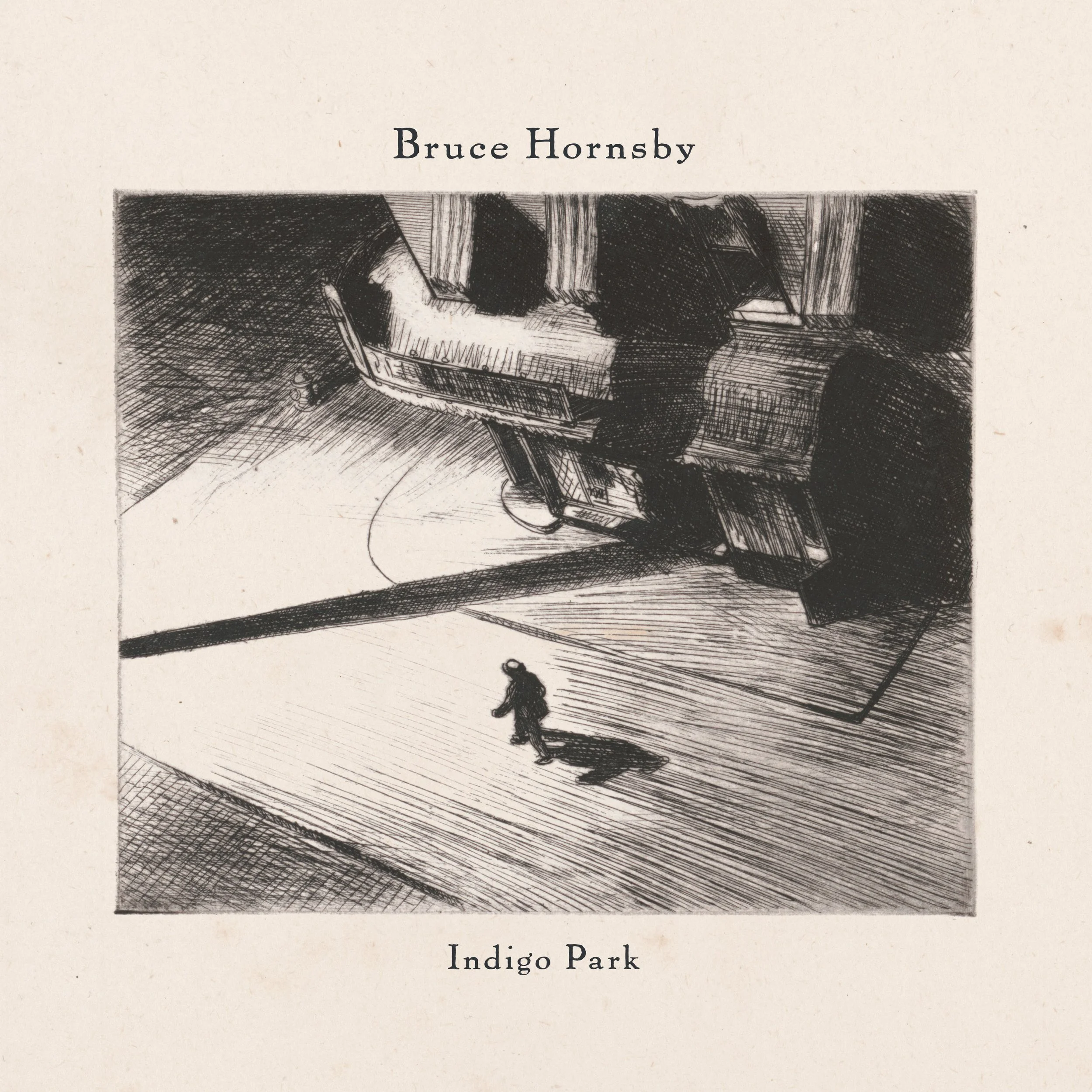
Cover: Edward Hopper - Night Shadows
Layout & Design by D. Norsen
Live Photo by Marc Finkelstein
Management: Marc Allan and Kevin Monty at Red Light Management
Ezra Koenig appears courtesy of Spring Snow / Columbia Records
Blake Mills appears courtesy of New Deal / Verve Records
Bruce Hornsby plays Steinway Pianos
Special Thanks to Kathy Hornsby, Patti & Bruce Springsteen, Marc Allan, Kevin Monty, Keith Hornsby, Russell Hornsby, Bobby Hornsby, Bob Jeffrey, Chuck Nimmo, Synjen Herren, Lee Dannay, David Macias and Lenny Waronker
About The Album
The refrain of “Ecstatic,” one of ten thoughtful songs on Bruce Hornsby’s new Indigo Park, describes the physiological sensations that often accompany a peak experience — the rush that’s common to surfing a massive untameable wave, or climbing a mountain, or composing a killer anthem.
Made my eyes jump round me,
Made my heart go beatin’ fast
Heard the roar come sounding,
Try to make the ecstatic last
The act of writing a song has been compared to bottling lightning; to compose is to chase the fleeting sense of the divine — and strive to somehow distill it into a precise constellation of rhythm and rhyme.
“Making the ecstatic last” is what every songwriter wakes up in the morning intending to do. It’s the job description, and also home court for Hornsby, whose discography includes a pile of enduring radio hits (“The Way It Is,” “Mandolin Rain,” “The End of the Innocence”) and critically acclaimed albums.
But on his new record, Hornsby isn’t aiming for breathless, shiny rhapsody every time. Another track finds him using the lexicon of physics to describe decline and decay: “Disorder near, entropy here,” he sings, in a gallows-haunted voice that sounds like it never encountered anything remotely like ecstasy. The hook: “I’m just trying to rust in peace.”
The ten songs of Indigo Park oscillate between those extremes. Light/dark. Memory/fantasy. Calm/rage. Doubt/certainty. One minute, Hornsby is using all the Beach Boys' earworm tools at his disposal to evoke the glorious, transcendent rush of air at the mountaintop. Then, a few songs later, he’s shuffling through a woozy bowery two-step, talking about sleeping on asphalt with an iron grate for a pillow. Telling anyone who’ll listen how the end of the world was not his fault.
These juxtapositions, so vivid in the rendering, are themselves a rarity now. Like many of his contemporaries, Hornsby is operating in a pop ecosystem that has grown narrower, more conformist, less adventurous. The edges and nuances that characterize so much of classic pop have been rounded off, disappeared, sanitized to satisfy the algorithm.
Hornsby’s response is to gleefully disregard those prevailing conditions. He goes full muso here, utilizing devices that, according to conventional wisdom anyway, the pop audience no longer has bandwidth for — absurdism, altered dominant chords, literary references, melodies with wide interval leaps, metaphor, changes of meter and texture, refrains that unfold over 16 measures rather than two.
Not only that: Indigo Park is a concept album of sorts, an extended multi-dimensional inquiry into the nature of memory — the ways certain scenes linger placidly while others balloon into imagined catastrophe, the ways we remember and the ways we forget. Throughout, Hornsby contemplates moments from his deep past, sometimes trying to “resolve” them, other times looking for clues about his present-day outlook. On the pensive “Silhouette Shadows,” he ends one story with a crisp dismissal: “Don’t know what I learned from that, maybe nothing.” On the hurtling train groove “Memory Palace,” which features vocals from Ezra Koenig of Vampire Weekend, Hornsby muses on the Fibonacci sequence and the mnemonic devices he uses to keep sharp, and then shares why he does it: “Make my time of solitude work so that my recall is true.”
In a culture that worships youth, it’s a radical thing to be a veteran artist undertaking an inquiry into the deceptions and faultlines of memory — a grown folks topic if there ever was. Hornsby sounds like he’s enjoying the challenge. He’s chasing the ecstatic at a full gallop because he knows how the clock tends to speed up as it’s running out.
“It’s just an old bastard, looking back,” Hornsby says of his new songs, with a smile of characteristic self-deprecation. “To be honest, I’ve found a way, a path to… grow old gracefully, with help from some newborn friends of mine.”
Those friends just happen to be the most in-demand rhythm section of the moment — guitarist Blake Mills, bassist Pino Palladino and drummer Chris Dave — a crew that’s supplemented by some of Hornsby’s longtime associates and guests including Bob Weir and Bonnie Raitt. The album was produced by Tony Berg, Will Maclellan and Bruce Hornsby.
The singer and composer credits this crew with helping, often accelerating, his musical evolution — by being open and receptive to his experimental spirit.
“I piss off a lot of my old fans who want me to make the same record every year, like so many of my singer-songwriter friends do,” Hornsby says. “I love these [artists] but they basically, stylistically, mine the same area. They’re not adventurous on a musical level at all, on a harmonic level. They’re not pushing that at all. They continue to lead a white note life.”
Acknowledging that he’s lost fans by not providing the expected artisanal nostalgia soak every few years, he says that he does not — cannot — care: “To mine the old and to be the vehicle for your stroll down memory lane, that’s a creative prison for me.”
To escape that fate, Hornsby has been methodically expanding the musical resources in his toolbox. For over a decade now, writing for his own records and film scores, he’s immersed himself in techniques far beyond the pop wheelhouse — exploring the knotty complex harmonies of contemporary classical composition, the syncopated shifts of jazz trio playing, the incessant finely chopped patterns of minimalism, unusual songforms in odd meters with interludes and moments of silence and questions hanging in the air. Touches that illuminate the corners of Indigo Park.
“Unfortunately for me, I went to the dark side several years ago and got deeply involved in the world of Messiaen and Ligeti and Elliott Carter and Schoenberg and Webern, and on and on and on. Keep naming them. That’s influenced my music, I think for the better — on an interesting, evolving level.”
Bruce Hornsby describes himself as a note taker. When an idea emerges, any kind of musical idea, he usually stops whatever he’s doing to pay attention to it. A feature of his studio is its clutter — there are notes on scraps of paper, notes on score paper, notes on napkins. “It’s just a creative space,” he says, “so it’s a big freaking mess.”
Indigo Park did not begin with Hornsby rushing to jot down slivers of inspiration, however. After the release of his 2024 album Deep Sea Vents, he realized he’d been writing and recording music at a near-constant clip for five years. That string of adventurous records began with acclaimed Absolute Zero (collaborations with Justin Vernon of Bon Iver, Jack DeJohnette), Non-Secure Connection (Vernon, James Mercer of The Shins, Jamila Woods, Leon Russell), ‘Flicted (yMusic, Koenig, Danielle Haim, DeJohnette), the water-themed concept album Deep Sea Vents, which furthered Hornsby’s fruitful collaboration with chamber group yMusic.
“It was about two years ago,” Hornsby recalls. “I’d made four records that had come out in five, six years, in 2019, 2020, 2022, and 2024, and another full record that’s never come out yet. I’d written about 54 songs or maybe more, new songs, in that time period. That’s a lot for me. I was really creatively fried. I was trying to not write songs. Trying my best.”
The composer vowed to turn off the tap for a while. Didn’t work.
“This one song idea just wouldn’t get out of my mind,” Hornsby recalls. “It wouldn’t go away….. I’d be lying in bed awake at 3:00 to 5:00 AM, and this thing’s roaring through my head, and I was, ‘No, get away. Out, damn you.’ It just wouldn’t let up. Finally, after about six months of giving it the Heisman as much as I could, stiff-arming it, I said, ‘Okay, hell with it. I’m going to deal with this.’”
That became “Indigo Park.” The verses chronicle episodes in the young life of Bruce; in classic pop fashion, the chorus lifts to higher altitude, to survey not just the remembered scene but the ways it has hung around, informing his adult perspective. Hornsby puts it this way: “Lessons learned through the years of boneheaded attempts and failures… Indigo Park is a state of mind.” The lyrics evoke that: “Oh let these days be your delight, captured in rhythm and rhyme, Watch these drawn lines trace your life’s most scintillating scenes.”
Among Hornsby’s own peak moments are the five songs he co-wrote with Robert Hunter, the legendary author of so many Grateful Dead lyrics. Two appear on Indigo Park — “Alabama” and “Might As Well Be Me, Florinda.”
Hornsby mentions “Alabama” as an example of his current experimental disposition, his predilection for worlds-in-collision smashups. It’s built around a collage-style array of loops, and includes an interpolation of Ligeti’s etude “L’Escalier Du Diable.” It’s tricky, stretchy music; Hornsby anticipates having to practice that passage for a while before he’ll be ready to perform it live. The track features a piano solo, something he hasn’t included on a record in years; he describes the inquisitive, fiery improvisation as “not your father’s Bruce Hornsby solo.”
When he first got Hunter’s lyrics, Hornsby recalls, he didn’t know what to do with them. “He was apologetic when he sent that one. The note said, ‘I don’t know what’s in here. I don’t know if there’s anything in here. I know it’s crazy as hell, but here it is.’ Maybe he was just trying to get it off his desk or something.”
Indigo Park contains another Hornsby/Hunter gem: the dystopian ramble “Might As Well Be Me, Florinda,” which centers around an electric vocal duet between Hornsby and Bob Weir, who also plays guitar on the track.
Hornsby says that all of his songwriting with the famously low-profile Hunter happened remotely. “I never saw him,” Hornsby says. “No. Not once. I’d tell him, ‘Hey, I’m coming to town to play so-and-so in the San Francisco area.’ He’d write me something that said, ‘I only go out for doctor’s visits now. I hardly ever leave the house. I can’t.’ Anyway, I hardly knew him. These five songs are what we did. I cherish that remote relationship.”
The album closes with “Take a Light Strain,” a sliver of soft-rock introspection that was inspired by a dream Hornsby had about his father. “I had this amazing dream, woke up in deep tears…. I dreamed I stood in the square room for a while. Then the door opens, my dad dressed in style in a white suit and matching shoes with a big smile and outstretched arms.”
Hornsby describes the dream as “a seriously real visitation.” “It happened a couple of years ago and I’ve never quite gotten over it — I had to make it into a song.” When he did, he discovered that to match the title’s message, he needed to create something streamlined, plain. “I told myself, ‘I’m just going to write something that I could have written 35 years ago.’ I used one of my father’s old country phrases — his way of saying ‘don’t worry about it,’ take it with a light strain… It’s an homage to my dad — and hey, it’s also beautiful advice.”